
BẠN ĐANG TÌM KIẾM CÁI GÌ?

In the fields of industrial automation and CNC machine tools, ball screws are the core transmission element that converts rotational motion into linear motion. Many people often make an intuitive mistake when selecting a screw: simply thinking that "the thicker the lead screw, the heavier things can be lifted."
In fact, the "carrying capacity" of a ball screw is a comprehensive index determined by the force direction, static/dynamic mechanical limits, and system installation constraints. For specialized applications, such as a precision ball screw for medical device applications, understanding the load-bearing capacity of the screw rod is especially important. It is not only related to whether the mechanical structure can push and pull normally, but also directly determines the operating accuracy and service life of the equipment.
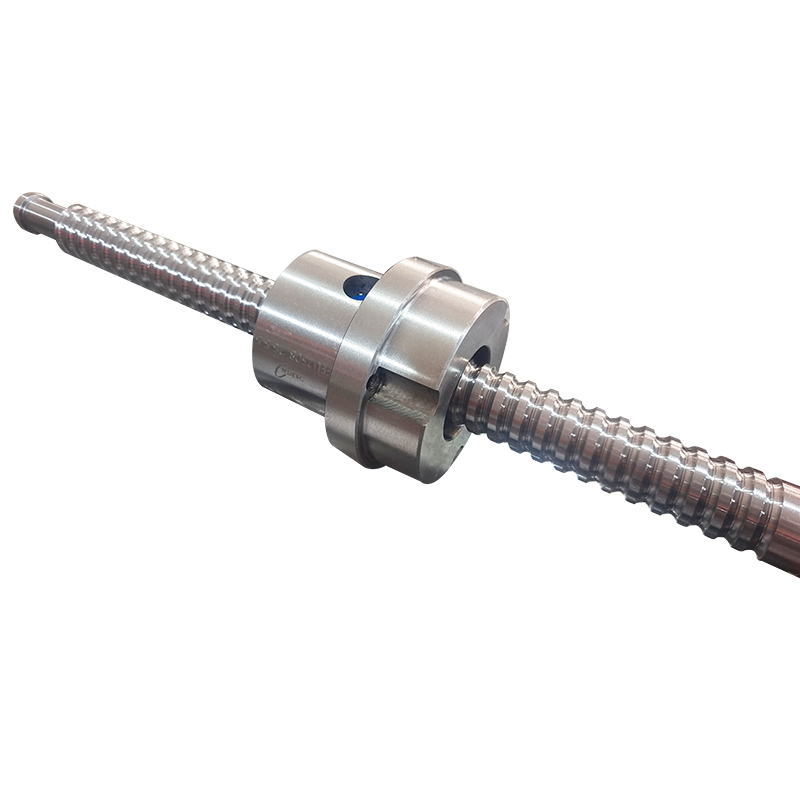
Core force principle: only "push and pull" is allowed, "side attack" is strictly prohibited
First of all, it is necessary to clarify the most fundamental force characteristics of the ball screw: it can only bear axial force.
• Ideal state: All load forces are concentrated along the central axis of the screw (thrust or pull).
• Physical taboos: The screw nut is extremely taboo against bearing radial forces or overturning moments.
If the structure is improperly designed, allowing the screw to directly hang heavy objects or bear lateral cutting forces will cause the balls to be unevenly stressed in the raceway, leading to eccentric wear, vibration, and even the slide rail becoming stuck or broken in a short period of time. This is particularly important when using a customized 4005 non-standard ball screw, as its design should be matched to the specific load, installation conditions, and operating requirements of the equipment.
Engineering standard practice: Linear guides or guide shafts must be configured in the mechanism to absorb all lateral weight and tilting moments, so that the ball screw purely plays the role of "providing axial push and pull power".
Two core parameters for selection: dynamic load vs static load
In the sample manual provided by the manufacturer, the two most critical indicators for evaluating load-bearing capacity are the rated dynamic load and the rated static load.
1. Rated dynamic load: determines "how long it can be used"
It refers to the constant axial load that 90% of the screws can withstand without metal fatigue spalling when the rated operating life of a set of identical ball screws is revolutions (1 million revolutions).
Selection rule of thumb: The average axial load in actual work is usually controlled within 10% ~ 30% of the dynamic rated load. If the screw is operated under high load for a long time, the life of the screw will be reduced exponentially.
2. Rated static load: determines "whether it will be crushed"
It refers to the ultimate axial load when the contact surface between the most stressed ball and the raceway produces the maximum permanent deformation (indentation) when the screw is stationary or running at very low speed.
Once the actual impact force exceeds, pits that are difficult to detect with the naked eye will appear inside the raceway. After that, every time the nut passes through a pit, it will vibrate violently, and the accuracy will be lost instantly.
The “three physical limits” that determine the actual load capacity
Even if the rated load of the selected nut is large enough, in the real physical world, the actual load capacity of the screw will be limited by the following three boundary conditions:
1. Instability limit of pressure rod (slenderness ratio and compressive yield)
When the ball screw is subjected to axial thrust (compressive stress), if the screw is too thin or too long, it will be "bent" from the middle like a bamboo pole. This phenomenon is called strut instability.
2. Load bottleneck of support bearings
The ball screw nut pushes the load, but the reaction force on the nut will eventually be transmitted to the fixed end support bearings (such as angular contact ball bearings) at both ends of the screw.
In many high-load conditions, the screw itself is not broken, nor is the nut. Instead, the fixed seat bearing is crushed first. The allowable axial load of the bearing must be checked when selecting.
Correction of operating environment and working conditions
When calculating the actual force, the theoretical axial force must be multiplied by the working condition coefficient to derive the equivalent dynamic load:
• 1. Smooth and impact-free (such as optical instruments, precision measuring equipment)
• 2. General automation
• 3. Heavy load/strong impact
Summary
Evaluating and improving the load-bearing capacity of ball screws is essentially a system engineering balance:
• Structurally: Use guide rails to absorb lateral forces to ensure that the screw only bears pure axial force.
• Calculation: Calculate the required, combined with the expected life, and leave sufficient margin with the impact coefficient.
• Physically: Verify the instability limit of the pressure rod under long strokes and ensure that the end fixed bearing can match the same endurance level.
Only when the screw body, support bearings and guide rail structure are considered as a whole can the stability and durability of the mechanical system be ensured while maximizing the load-bearing potential.
Vui lòng đọc tiếp, tiếp tục đăng, đăng ký và chúng tôi hoan nghênh bạn cho chúng tôi biết suy nghĩ của bạn.


 Hỗ trợ mạng IPv6

 ĐĂNG KÝ NHẬN BẢN TIN CỦA CHÚNG TÔI